How to Know If Your League Schedule Is Fair
Quick answer: a league schedule is fair when every team gets the same chances on five things: opponents, time slots, rest between games, byes and home or away games. Count each one per team before you publish. A good rule of thumb: no team has more than half its games in one time slot, bye counts differ by no more than 1, and no two teams meet twice before every pair has met once.
You spent hours building the perfect schedule. Game times are set, fields are booked, and you finally clicked publish. Then the emails start rolling in:
"Why does my team always play at 9 PM?"
"We've played the same team three times and haven't even faced half the league."
"How come the Wildcats get two bye weeks and we don't get any?"
Sound familiar? These complaints usually aren't about the schedule being wrong. They're about it feeling unfair. And in recreational sports, perception matters just as much as reality.
The good news: schedule fairness isn't subjective. There are concrete factors you can measure, and once you know what to look for, you can fix problems before anyone complains.
What Makes a Schedule "Fair"?
A fair schedule gives every team an equal opportunity to compete. That means:
- Balanced opponents - Everyone plays everyone (or as close as possible)
- Balanced time slots - No team is stuck with all the early morning or late night games
- Balanced rest - Similar gaps between games for all teams
- Balanced byes - If byes exist, they're distributed evenly
- Balanced home/away - For leagues that track this, it should be roughly 50/50
| Check | Count per team | Red flag |
|---|---|---|
| Opponents | Games against each other team | A pair meets 3 times while another pair never meets |
| Time slots | Games in each start time | More than half a team's games in one slot |
| Rest | Days between games | One team regularly gets 2 days, another 10 |
| Byes | Weeks off | Bye counts differ by 2 or more |
| Home and away | Home games vs away games | Worse than an even split by more than 2 |
Let's break down each one.
1. Balanced Opponents
In a full round robin, every team plays every other team the same number of times: 8 teams need 7 weeks to meet once. Most rec leagues run 7 to 12 weeks, so with more teams than that you end up with a partial schedule, and the question becomes who plays whom. See how to create a round robin schedule.
What to check:
- Has every team played every other team at least once?
- Is there a big gap between matchup counts? (e.g., Team A played Team B three times but never played Team C)
Red flags:
- Two teams haven't faced each other all season
- One matchup has happened 3+ times while others only happened once
- A team has played the top-ranked team multiple times while another team avoided them entirely
The fix: Use a schedule generator that prioritizes opponent variety. If you're editing manually, look at a team-vs-team matrix to spot gaps before you publish.
2. Balanced Time Slots
This is the #1 source of complaints. Nobody wants to be the team that always plays at 6 AM on Saturday or 10 PM on a weeknight.
What to check:
- Count how many times each team plays in each time slot
- Look for teams with more than 50% of their games in a single slot
Red flags:
- One team plays 6 of their 8 games at 9 PM
- The "best" time slot (usually mid-morning or early evening) is dominated by the same few teams
- A team never gets the primetime slot
The fix: Rotate time slots intentionally. Some generators do this automatically. If you're building manually, create a rotation order and stick to it. Don't just fill slots top to bottom.
3. Balanced Rest (Game Gaps)
This one is subtle but matters for competitive balance. A team that plays back-to-back games has a disadvantage against a team that had a week off.
What to check:
- What's the minimum and maximum gap between games for each team?
- Are any teams consistently getting short rest while others get long breaks?
Red flags:
- One team plays Tuesday and Thursday the same week while another team has 10 days between games
- A team has three "short rest" situations while others have zero
The fix: When building schedules with multiple games per week, track the gaps. Aim for consistency: if one team has a short turnaround, others should too.
4. Balanced Byes
Byes are unavoidable when you have an odd number of teams or limited facility time. But they need to be distributed fairly.
What to check:
- Does every team have the same number of byes?
- Are byes spread throughout the season or clustered?
Red flags:
- One team has three byes while another has zero
- A team gets a bye in week 1 AND week 2 (essentially missing the start of the season)
- Playoff-critical weeks have uneven byes
The fix: Count byes per team before publishing. If they're uneven, swap some games around. Also consider bye timing: a bye during rivalry week feels different than a bye during a slow week.
5. Balanced Home/Away
For leagues that use home and away designations (even if you play at the same field), this affects jersey colors, bench assignments, and sometimes even scorekeeping duties.
What to check:
- Count home vs. away games per team
- Should be as close to 50/50 as possible
Red flags:
- A team has 7 home games and 1 away game
- The same two teams always have the same home/away assignment when they play each other
The fix: Alternate home/away when teams play multiple times. Most schedule generators handle this automatically, but double-check if you've made manual edits.
How to Audit Your Schedule
You could check all of this manually with a spreadsheet, but that's tedious and error-prone. Here's a faster approach:
Option 1: Quick eyeball test
Pick your newest team and your most established team. Compare their schedules side by side. Do they look roughly equal in time slots, opponents, and rest?
Option 2: Spot check the extremes
Find the team with the most 9 PM games. Find the team with the fewest. If the gap is more than 2-3 games, you have a problem.
Option 3: Use a schedule quality checker
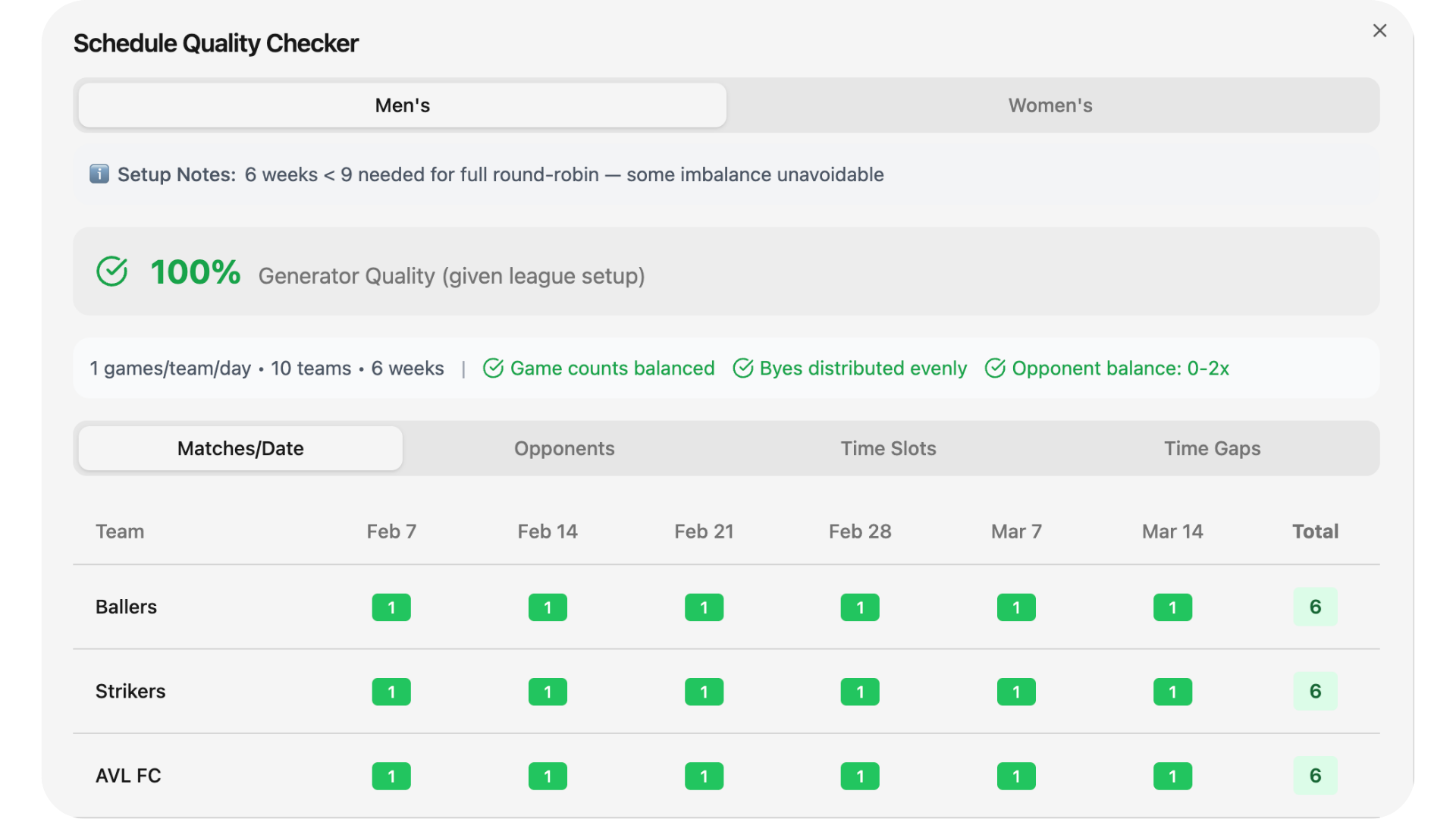
Some league management tools have built-in schedule analysis. SportsGrove's schedule checker counts each team's opponents, time slots, gaps between games, games per date and byes, and flags uneven byes. It takes seconds instead of hours and catches things you might miss.
What If Your Schedule Isn't Fair?
Don't panic. Most fairness issues can be fixed with a few swaps:
- Identify the worst imbalance - Focus on the biggest problem first
- Find a swap that helps - Look for two games you can switch that improve the situation without creating new problems
- Re-check after changes - One fix can create another issue, so verify the whole schedule again
- Communicate proactively - If you catch a problem and fix it before teams notice, you look organized. If they catch it first, you're playing defense.
For major issues, you might need to regenerate part of the schedule. This is easier if you use software that lets you lock certain games (like ones already played) while regenerating the rest.
Prevention Is Easier Than Fixing
The best way to handle fairness complaints is to prevent them:
- Use a schedule generator that considers fairness factors, not just availability
- Check the schedule quality before you publish, not after complaints roll in
- Share the metrics with team captains ("Every team plays each opponent 2-3 times, everyone has one bye, time slots are rotated")
- Document your methodology so you can explain decisions if questioned
When teams understand that you have a fair system, even if the results aren't perfect, they're much more likely to accept the schedule without complaint.
The Bottom Line
A fair schedule isn't about making everyone happy. It's about giving every team an equal shot. That means balanced opponents, balanced time slots, balanced rest, balanced byes, and balanced home/away splits.
You don't need to achieve perfection-you need to avoid major imbalances and be able to explain your process.
Take 10 minutes to audit your next schedule before you publish. Your inbox will thank you.
In SportsGrove, the schedule is built across your courts and time slots with byes spread evenly, and the schedule checker shows the counts above before you publish. For a one-off event, the free tournament time calculator and printable round robin schedules do the math for you.
Frequently asked questions
How do I know if my league schedule is fair?
Count five things per team before you publish: games against each opponent, games in each time slot, days of rest between games, byes, and home or away games. Large gaps between teams on any of them are what players notice.
How many byes should each team get?
As close to equal as possible. With an odd number of teams, one team sits out each week, so over a full round robin every team gets exactly one bye. Bye counts that differ by 2 or more are a red flag.
How do I stop one team always playing the late game?
Rotate start times on purpose: give each team a set order through the time slots instead of filling slots from the top. No team should have more than half its games in one slot.
What if my league doesn't have enough weeks for every team to play every other team?
Make sure no pair meets twice before every pair has met once, and spread each team's opponents across strong and weak teams. With 12 teams and 7 weeks, each team plays 7 of the other 11.
Should a schedule balance home and away games?
Yes, if your league uses home and away for jerseys, benches or scorekeeping. Aim for an even split, and alternate home and away when two teams meet more than once.
Ready to start your league?
SportsGrove handles registration, scheduling, payments and messages, so you can focus on running great game nights.
No credit card required · 30-day free trial