How to Create a Round Robin Schedule for Any Number of Teams
Quick answer: a round robin with n teams has n × (n - 1) ÷ 2 games. Each team plays n - 1 games, over n - 1 rounds when the number of teams is even, or n rounds when it's odd, because one team sits out (has a bye) each round. So 6 teams play 15 games in 5 rounds, and 8 teams play 28 games in 7 rounds.
Round robin is the most popular format for recreational sports leagues-and for good reason. Every team plays every other team. No one gets eliminated early. Everyone gets their money's worth.
But actually creating a round robin schedule? That's where organizers get stuck. How many weeks do you need? What if you have an odd number of teams? How do you make sure the time slots are fair?
This guide breaks down the math, shows you the methods, and helps you build a balanced schedule for any number of teams.
What is Round Robin?
In a round robin format, every team plays every other team at least once. There are no eliminations-everyone plays the full season. At the end, standings are determined by wins, losses, and tiebreakers.
Pros:
- Fair-everyone plays the same opponents
- More games per team than elimination formats
- Standings reflect overall performance, not single-game luck
Cons:
- Takes more weeks to complete
- Some games late in the season may feel "meaningless" if standings are decided
- Requires balanced scheduling to be fair
Round robin works best for leagues with 4-10 teams. Larger leagues often split into divisions with round robin play within each division.
The Basic Math
Before you build a schedule, you need to know how many games and weeks you're working with.
Total games in a round robin:
Total games = Teams × (Teams - 1) ÷ 2
Games per team = Teams - 1
Rounds = Teams - 1 (even number of teams)
Rounds = Teams (odd number of teams, one bye each round)
An 8-team league plays 28 games: each team plays 7, one a week for 7 weeks.
Round Robin at a Glance: 3 to 16 Teams
Every row links to a free printable schedule you can fill in with your team names.
| Teams | Total games | Games per team | Rounds | Games per round | Bye each round | Printable schedule |
|---|---|---|---|---|---|---|
| 3 | 3 | 2 | 3 | 1 | Yes | 3-team schedule |
| 4 | 6 | 3 | 3 | 2 | No | 4-team schedule |
| 5 | 10 | 4 | 5 | 2 | Yes | 5-team schedule |
| 6 | 15 | 5 | 5 | 3 | No | 6-team schedule |
| 7 | 21 | 6 | 7 | 3 | Yes | 7-team schedule |
| 8 | 28 | 7 | 7 | 4 | No | 8-team schedule |
| 9 | 36 | 8 | 9 | 4 | Yes | 9-team schedule |
| 10 | 45 | 9 | 9 | 5 | No | 10-team schedule |
| 11 | 55 | 10 | 11 | 5 | Yes | 11-team schedule |
| 12 | 66 | 11 | 11 | 6 | No | 12-team schedule |
| 13 | 78 | 12 | 13 | 6 | Yes | 13-team schedule |
| 14 | 91 | 13 | 13 | 7 | No | 14-team schedule |
| 15 | 105 | 14 | 15 | 7 | Yes | 15-team schedule |
| 16 | 120 | 15 | 15 | 8 | No | 16-team schedule |
Above about 10 teams, a single round robin runs longer than most rec seasons. A 12-team league needs 11 weeks; split it into two divisions of 6 and each division finishes in 5.
Handling Odd Numbers of Teams
If you have an odd number of teams, one team will have a bye (week off) each round.
Example: 5 teams
Each week, 4 teams play (2 games) and 1 team has a bye. Over 5 weeks, every team gets exactly one bye.
Tips for bye weeks:
- Rotate byes so they're spread evenly
- Don't give the same team early and late byes (feels unfair)
- Some leagues have the bye team referee or scorekeep
The Circle Method (How to Build It Manually)
The most reliable way to create a round robin schedule by hand is the circle method. Here's how it works:
Step 1: Arrange teams in two rows facing each other. If you have an odd number, add a "BYE" placeholder.
For 6 teams:
Row 1:  1   2   3
Row 2:  6   5   4
Teams across from each other play: 1v6, 2v5, 3v4
Step 2: Keep Team 1 fixed. Rotate all other teams clockwise.
Round 2:
Row 1:  1   6   2
Row 2:  5   4   3
Matchups: 1v5, 6v4, 2v3
Step 3: Continue rotating until you're back to the starting position.
Round 3:
Row 1:  1   5   6
Row 2:  4   3   2
Matchups: 1v4, 5v3, 6v2
And so on...
After Teams - 1 rotations (5 rounds for 6 teams), every team has played every other team exactly once.
Time Slot and Court Assignments
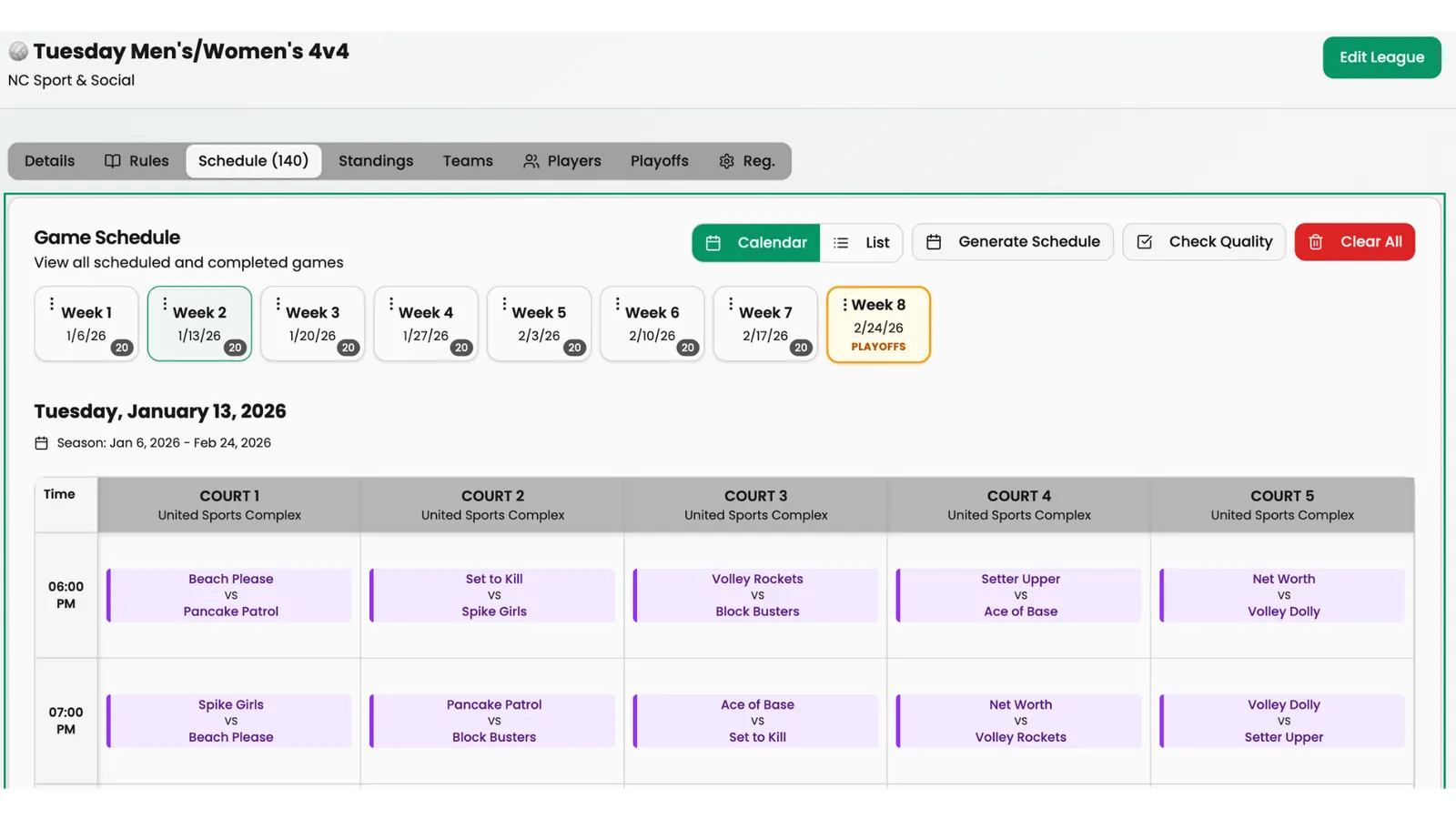
Once you have your matchups, you need to assign them to time slots and courts. This is where fairness gets tricky.
Goals:
- No team should always play the early slot
- No team should always play the late slot
- If you have multiple courts, balance court assignments too
Simple approach: Rotate positions within each round.
Round 1:
- 6:00 PM - Court 1: Team 1 vs Team 6
- 6:00 PM - Court 2: Team 2 vs Team 5
- 7:00 PM - Court 1: Team 3 vs Team 4
Round 2:
- 6:00 PM - Court 1: Team 2 vs Team 3
- 6:00 PM - Court 2: Team 1 vs Team 5
- 7:00 PM - Court 1: Team 6 vs Team 4
The key is tracking and balancing over the full season, not just one week.
Home and Away Balance
In some sports, "home" and "away" matter-even in rec leagues where everyone plays at the same venue. Home team might:
- Be listed first on the schedule
- Wear certain jerseys
- Provide the game ball
- Have first choice of bench/side
To balance home/away:
- Each team should have roughly equal home and away games
- In a 7-game season, aim for 3-4 home and 3-4 away per team
- Alternate when the same teams meet twice (in double round robin)
Double Round Robin
Want a longer season? Run a double round robin where every team plays every other team twice-once "home" and once "away."
Math:
Total Games = Teams × (Teams - 1)
| Teams | Games (Double RR) |
|---|---|
| 6 | 30 |
| 8 | 56 |
This doubles your season length but gives more games and evens out fluky results.
Common Scheduling Mistakes
1. Unbalanced time slots
If Team A plays at 9 PM five weeks in a row while Team B always plays at 6 PM, you'll hear complaints. Track slot assignments and balance them.
2. Repeat matchups too close together
In a double round robin, don't schedule Team A vs Team B in weeks 1 and 2. Spread rematches across the season.
3. Forgetting bye weeks
With odd numbers, someone always has a bye. Make sure it rotates fairly and communicate it clearly.
4. Last-minute changes without checking conflicts
If you reschedule a game, make sure neither team has a conflict. A team playing twice in one night or back-to-back weeks against the same opponent creates problems.
5. Not publishing the schedule early enough
Players need time to plan around league nights. Publish your schedule at least 1-2 weeks before the season starts.
Example: 8-Team Schedule
Here's a complete round robin for 8 teams over 7 weeks:
Week 1:
- 1 vs 8
- 2 vs 7
- 3 vs 6
- 4 vs 5
Week 2:
- 1 vs 7
- 8 vs 6
- 2 vs 5
- 3 vs 4
Week 3:
- 1 vs 6
- 7 vs 5
- 8 vs 4
- 2 vs 3
Week 4:
- 1 vs 5
- 6 vs 4
- 7 vs 3
- 8 vs 2
Week 5:
- 1 vs 4
- 5 vs 3
- 6 vs 2
- 7 vs 8
Week 6:
- 1 vs 3
- 4 vs 2
- 5 vs 8
- 6 vs 7
Week 7:
- 1 vs 2
- 3 vs 8
- 4 vs 7
- 5 vs 6
Every team plays every other team exactly once. Now assign time slots and courts to balance the load. You can print this one as the free 8 team round robin schedule, with your team names filled in.
When Round Robin Isn't Enough
Round robin works great for smaller leagues, but it has limits:
- Too many teams: A 16-team round robin needs 15 weeks. That's a long season.
- Mixed skill levels: When top and bottom teams are far apart, some games become blowouts.
- Lack of stakes: Late-season games may feel meaningless if standings are locked.
Alternatives to consider:
- Divisions: Split into two 8-team divisions with round robin in each, then cross-division playoffs.
- Promotion/Relegation: Teams move between divisions based on performance. Every game matters because you're fighting to move up or stay up.
- Shortened round robin + playoffs: Play partial round robin to seed teams, then single/double elimination playoffs.
Let Software Do the Work
Building a round robin schedule by hand is doable for small leagues. But once you add:
- Multiple divisions
- Court constraints
- Time slot balancing
- Home/away tracking
- Bye week rotation
...it gets complicated fast.
League software like SportsGrove builds the round robin across your courts and time slots, rotates the byes, and checks the schedule for fairness before you publish it. For a one-day event, the tournament planner runs pool play round robins into a bracket.
You can spend an evening with spreadsheets, or you can spend five minutes with the right tool and move on with your life.
Summary
Round robin basics:
- Every team plays every other team
- Total games = Teams × (Teams - 1) ÷ 2
- Weeks needed = Teams - 1 (even) or Teams (odd)
Keys to a good schedule:
- Balance time slots across the season
- Rotate byes fairly for odd-numbered leagues
- Track home/away assignments
- Publish early so players can plan
When to use it:
- Leagues with 4-10 teams
- When you want fair, comprehensive competition
- When you have enough weeks in your season
Now go build your schedule-or let software do it for you.
Frequently asked questions
How many games are in a 4 team round robin?
6 games over 3 rounds. Each team plays 3 games, and there are no byes.
How many games are in a 5 team round robin?
10 games over 5 rounds. Each team plays 4 games and sits out one round.
How many games are in a 6 team round robin?
15 games over 5 rounds, 3 games a round. Each team plays 5 games.
How many games are in an 8 team round robin?
28 games over 7 rounds, 4 games a round. Each team plays 7 games.
What is the formula for a round robin?
Total games = n × (n - 1) ÷ 2, where n is the number of teams. Each team plays n - 1 games.
How many games are in a double round robin?
Twice as many: n × (n - 1). With 4 teams that's 12 games, and each team plays 6, meeting every opponent twice.
Can a 5 or 7 team round robin have no byes?
Not if every team plays once per round: with an odd number of teams, one team sits out each round. To avoid empty nights, play two rounds a night, so a different team sits out each round and everyone plays at least once.
Is there a free round robin schedule maker?
Yes. SportsGrove has free printable round robin schedules for 3 to 16 teams: add your team names and print, no sign-up needed.
Ready to start your league?
SportsGrove handles registration, scheduling, payments and messages, so you can focus on running great game nights.
No credit card required · 30-day free trial