What is a Promotion/Relegation League? The Format That Keeps Every Game Exciting
If you've ever run a recreational sports league, you've seen it happen: by week four, half the teams know they have no shot at the playoffs. They start showing up with fewer players. Effort drops. Forfeits increase. The bottom of the standings becomes a ghost town while the top teams cruise to predictable finishes.
It doesn't have to be this way.
Promotion/relegation is a league format used across professional sports worldwide-and it solves this exact problem. Every game matters. Every team has something to play for. And the competition stays balanced all season long.
Until recently, this format was nearly impossible to run at the recreational level. The logistics were too complex for spreadsheets and manual scheduling. But that's changed. Now you can offer your players something most rec leagues don't: a season where the standings actually mean something, week after week.
How Promotion/Relegation Works
The concept is simple: teams move between divisions based on how they perform.
The basic structure:
- Divide teams into tiers. Instead of one big league, you create multiple divisions ranked by skill or performance. Division A is the top tier, Division B is the middle, Division C is the lower tier, and so on.
- Play in periods. The season is broken into chunks-typically 2-4 weeks each. During each period, teams play against others in their own division.
- Promote and relegate. At the end of each period, the top teams from each division move UP to the next tier. The bottom teams move DOWN. The middle stays put.
- Repeat. The next period begins with reshuffled divisions. Teams that were struggling now face easier competition. Teams that dominated face tougher opponents.
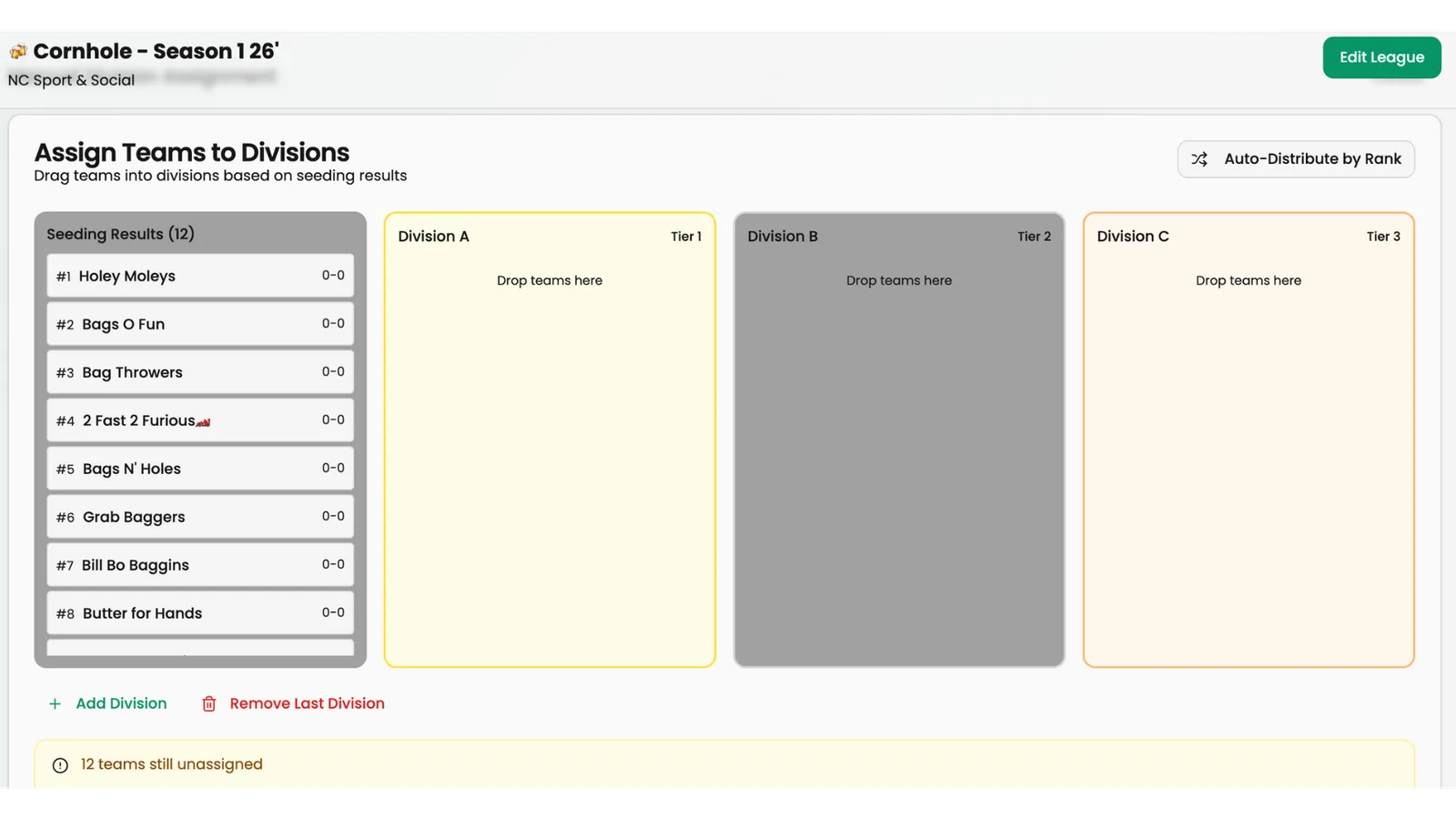
Example: A 12-team cornhole league
- Division A: Teams ranked 1-4
- Division B: Teams ranked 5-8
- Division C: Teams ranked 9-12
After the first 3-week period:
- Top 2 from Division B move up to Division A
- Bottom 2 from Division A move down to Division B
- Same movement between B and C
Now the divisions are reshuffled based on actual performance, not preseason guesses. The competition rebalances automatically.
Why This Format Changes Everything
Every game matters-all season long
In a traditional league, once you're mathematically eliminated from playoffs, the rest of your season is meaningless. You're just playing out the string.
In a promotion/relegation format, there's no "meaningless" stretch. Even if you're in the bottom division, you're fighting to move up. Even if you're at the top, you're fighting to stay there. The stakes reset every few weeks.
This keeps players engaged. It keeps them showing up. It keeps them trying.
Competition stays balanced
Nothing kills fun faster than lopsided games. When a first-place team plays a last-place team, neither side has a great time. The better team coasts. The weaker team gets demoralized.
Promotion/relegation solves this naturally. After a period or two, teams settle into divisions where they're playing opponents of similar skill. Games get closer. Outcomes get less predictable. Everyone has more fun.
It rewards improvement, not just talent
In a traditional format, if your team starts slow, you're stuck at the bottom all season. Your only hope is a miracle playoff run.
With promotion/relegation, a team that gels midseason can climb the ranks. You're not defined by your first few weeks. You're defined by how you respond. That's a more satisfying story for players to be part of.
It creates genuine drama
"Win and we move up to Division A."
"Lose and we drop to Division C."
These are the kinds of stakes that get people talking, texting their teammates, and actually caring about a Tuesday night cornhole match. You're not just playing for a trophy at the end of the season-you're playing for something real, right now.
Why You Don't See This in Rec Leagues (Yet)
If promotion/relegation is so great, why isn't everyone doing it?
Because it's a logistical nightmare to manage manually.
Think about what's required:
- Track standings across multiple divisions simultaneously
- Recalculate who promotes and relegates after each period
- Rebuild the schedule for the next period with new division compositions
- Make sure teams don't repeat the same matchups too often across the season
- Communicate all the changes clearly to every team
With spreadsheets? That's hours of work every few weeks. One mistake and your standings are wrong, your schedule is unfair, or your players are confused.
Most rec league organizers are volunteers or running leagues as a side project. They don't have time to manually manage a complex format. So they stick with simple round robin or bracket formats-even though those formats have real problems.
The tools haven't existed-until now.
Professional leagues have entire operations teams to manage promotion/relegation. Rec leagues have... you, maybe a co-organizer, and whatever time you can squeeze in between your actual job.
That's why we built promotion/relegation directly into SportsGrove. The software handles the complexity so you don't have to.
How SportsGrove Makes It Easy
Running a promotion/relegation league in SportsGrove works like this:
1. Set up your league and choose the format.
When creating your league, select "Promotion/Relegation" as the format. Choose how long each period lasts (2, 3, or 4 weeks) and how many divisions you want.
2. Start with a seeding period (optional).
If you don't know how to rank teams initially, run a seeding period where everyone plays together. The results determine who starts in which division. Or skip seeding and assign teams manually if you already know the skill levels.
3. Generate the schedule.
SportsGrove creates balanced schedules for each period automatically. It tracks who has played who across the entire season, so teams get variety in their matchups even as divisions reshuffle.
4. Play the period and enter scores.
Standings update in real-time. Players can see exactly where they sit and what's at stake.
5. Promote and relegate.
When the period ends, you see the standings and decide who moves. The software suggests promotions and relegations based on results, but you have final say. Want to keep two friends in the same division? Override the suggestion. It's your league.
6. Start the next period.
Generate the new schedule with updated divisions. The software remembers matchup history and avoids excessive repeats. Players see their new division assignments and the games they're playing.
Repeat until the season ends.
At the end of the season, you have cumulative standings showing how every team performed across all periods-plus the story of their journey through the divisions.
Who Should Run a Promotion/Relegation League?
This format isn't for every situation. It works best when:
- You have 12+ teams. You need enough teams to create meaningful divisions. Three divisions of 4+ teams each is a good starting point.
- Your league runs 6+ weeks. You need time for multiple periods. A 3-week league doesn't have room for teams to move around.
- Skill levels vary. If all your teams are roughly equal, promotion/relegation doesn't add much. But if you have a mix of competitive and casual players, this format keeps everyone engaged.
- You want to stand out. Most rec leagues run the same format everyone else does. Promotion/relegation gives your players something different-something they'll talk about and remember.
Sports where this works great:
- Cornhole leagues (especially bar leagues with lots of teams)
- Pickleball ladder leagues
- Soccer leagues with multiple skill levels
- Volleyball leagues
- Bocce leagues
- Really, any sport where you have enough teams and enough weeks
What Players Actually Experience
Here's what a season feels like for a player in a promotion/relegation league:
Weeks 1-3 (Seeding): "We're playing everyone to see where we land. Let's try to get into Division A."
Week 4 (Division placement): "We made Division B. Not bad-let's see if we can move up."
Weeks 4-6 (Period 1): "We're 2-0 in Division B. One more win and we're probably promoting to A!"
Week 7 (Promotion): "We did it-Division A next period. Time to see if we can hang with the top teams."
Weeks 7-9 (Period 2): "Division A is tough. We're 1-2 but fighting to stay up."
Week 10: "Last game of the period. Win and we stay in A. Lose and we drop back to B. Everything's on the line."
That's a story. That's stakes. That's something worth showing up for on a weeknight.
Compare that to a traditional league where the same player might be thinking: "We're 3-4, we'll probably miss playoffs. These last few games don't really matter."
Which experience would you rather give your players?
Stand Out from Every Other League in Town
Here's the reality: most recreational sports leagues are interchangeable. Same format. Same structure. Same experience.
If you're trying to grow a league-or just keep the players you have coming back-you need something that sets you apart. Promotion/relegation is that something.
It's the format that players in Europe have loved for over a century. It's what makes the Premier League, La Liga, and Bundesliga so compelling. And now you can bring that same energy to your Tuesday night cornhole league at the local brewery.
The hard part used to be managing it. That's not a problem anymore.
Ready to Run a Promotion/Relegation League?
SportsGrove is built for exactly this. Set up your divisions, generate schedules, track standings, and manage promotions-all in one place.
Give your players a league they'll actually talk about. Start your free trial at SportsGrove and launch a promotion/relegation league this season.
Ready to start your league?
SportsGrove handles registration, scheduling, payments and messages, so you can focus on running great game nights.
No credit card required · 30-day free trial