Single Elimination vs Double Elimination: Which Tournament Format to Use
You've got teams ready to compete. Now you need to decide: single elimination or double elimination?
Both formats crown a champion through bracket play, but they create very different experiences for players and organizers. This guide breaks down how each format works, the pros and cons, and when to use which one for your tournament or playoff.
How Single Elimination Works
Single elimination is simple: lose once and you're out.
Structure:
- Teams are seeded into a bracket
- Winners advance, losers go home
- Continue until one team remains undefeated
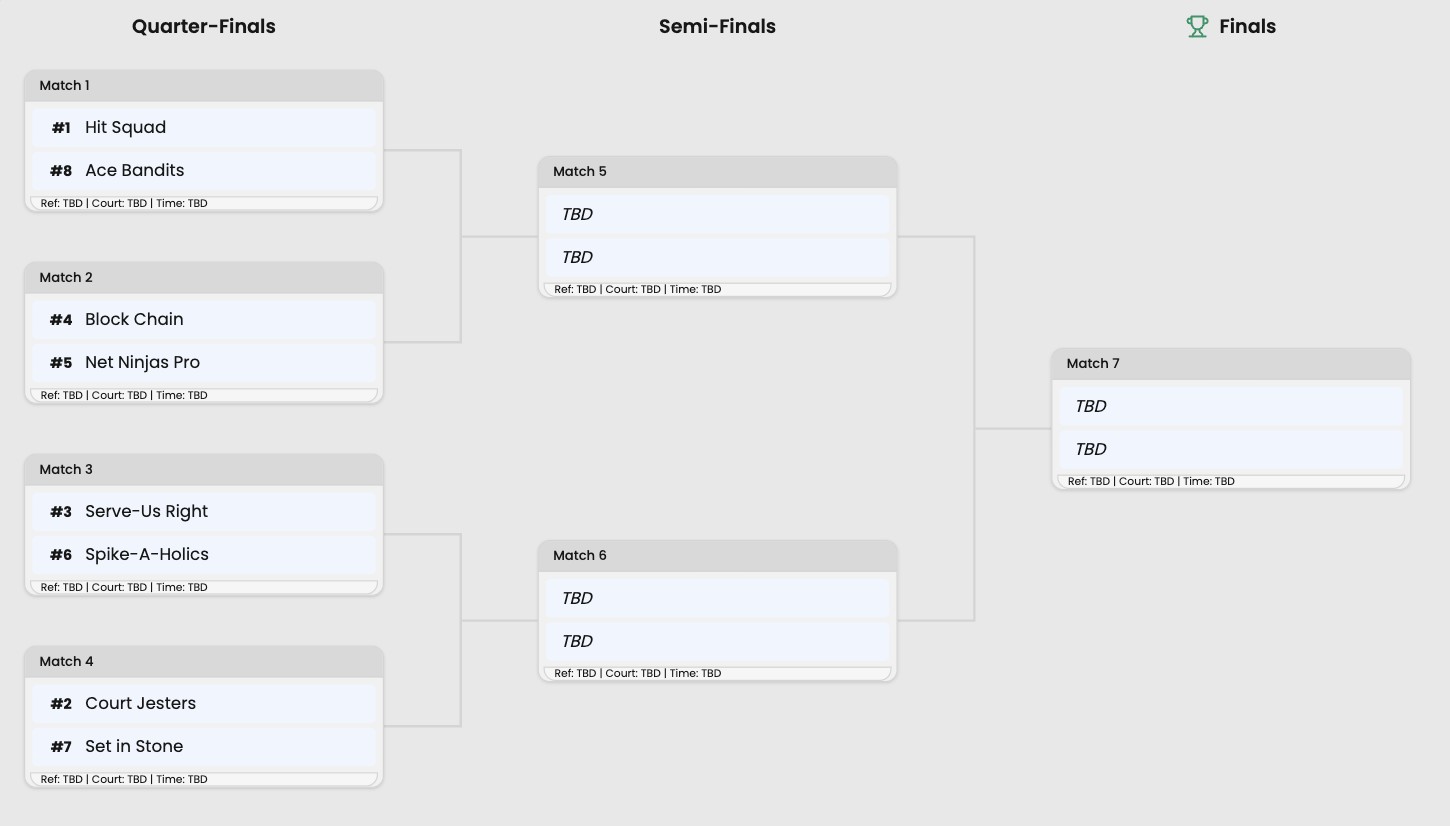
Total games: Teams - 1
| Teams | Games |
|---|---|
| 4 | 3 |
| 8 | 7 |
| 16 | 15 |
| 32 | 31 |
How Double Elimination Works
Double elimination gives every team a second chance: you must lose twice to be eliminated.
Structure:
- Starts like single elimination (winner's bracket)
- First loss drops you to the loser's bracket
- Lose in the loser's bracket and you're out
- Winner's bracket champion plays loser's bracket champion in the finals
- If the loser's bracket team wins, a second "true final" is often played
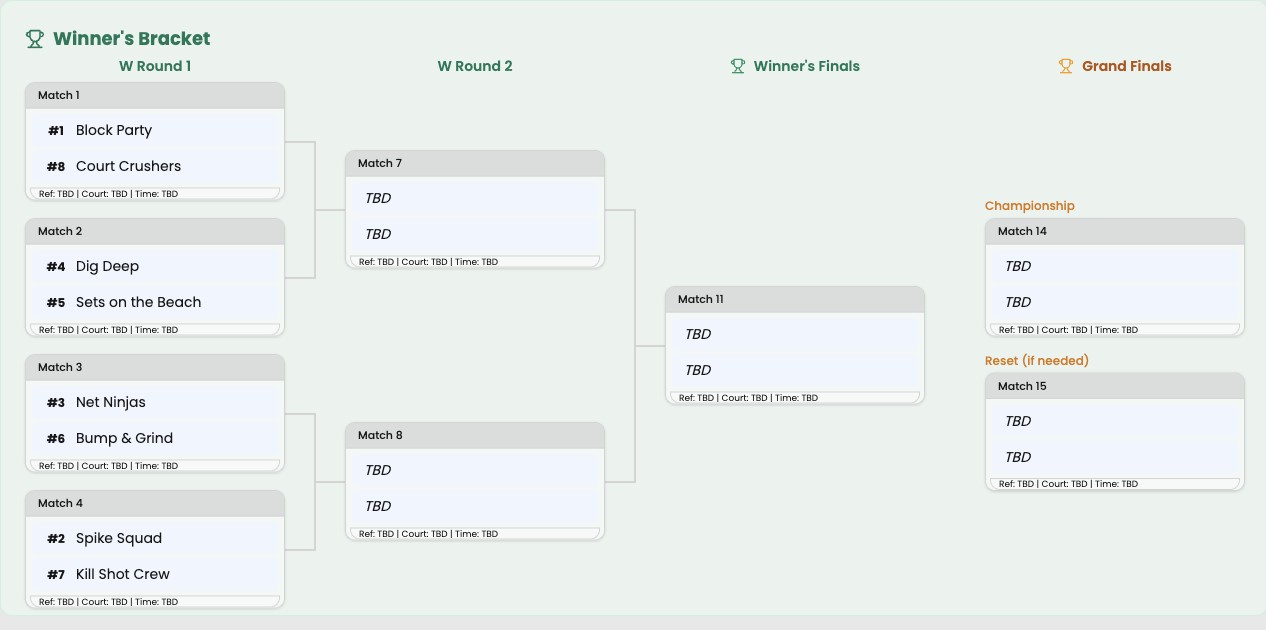
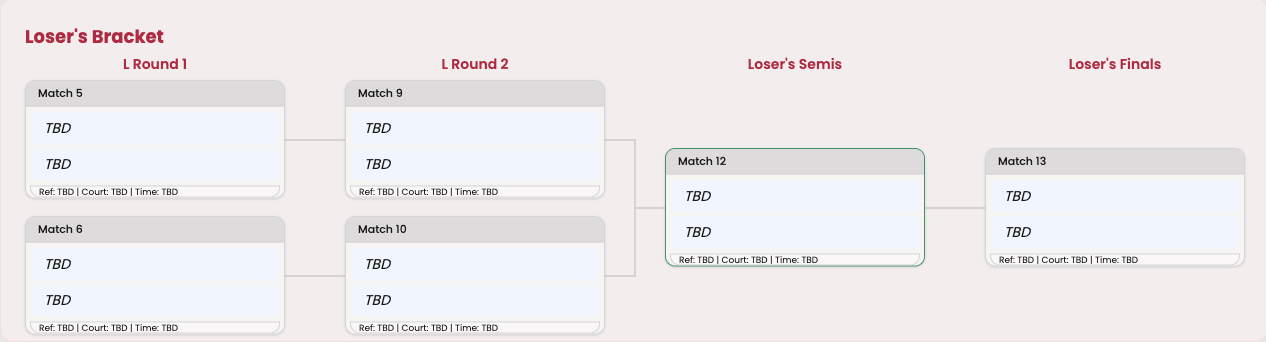
Total games: Between (2 × Teams - 2) and (2 × Teams - 1)
Double elimination gives every team a second chance: you must lose twice to be eliminated.
Structure:
- Starts like single elimination (winner's bracket)
- First loss drops you to the loser's bracket
- Lose in the loser's bracket and you're out
- Winner's bracket champion plays loser's bracket champion in the finals
- If the loser's bracket team wins, a second "true final" is often played
Total games: Between (2 × Teams - 2) and (2 × Teams - 1)
| Teams | Games (min-max) |
|---|---|
| 4 | 6-7 |
| 8 | 14-15 |
| 16 | 30-31 |
| 32 | 62-63 |
The range exists because the finals may require one or two games depending on who wins.
Side-by-Side Comparison
| Factor | Single Elimination | Double Elimination |
|---|---|---|
| Games to play | Teams - 1 | ~2× as many |
| Time required | Short | Long |
| Second chances | None | Yes |
| Upsets stick | Yes | Can be corrected |
| Best team usually wins | Sometimes | More often |
| Player satisfaction | Lower (one-and-done) | Higher (guaranteed 2+ games) |
| Complexity | Simple | More complex |
| Drama | High (every game matters) | Sustained (comeback stories) |
When to Use Single Elimination
Choose single elimination when:
1. Time is limited
Single elimination is fast. An 8-team bracket finishes in 7 games. If you have a one-day tournament with limited hours, single elimination lets you crown a champion without running late.
2. You want maximum stakes
Every game is win-or-go-home. There's something electric about that pressure. Upsets happen. Cinderella stories emerge. The tension is constant.
3. You have a large field
32 teams in double elimination means 62+ games. That's a massive undertaking. Single elimination keeps large tournaments manageable.
4. It's a playoff after a full season
If teams have played 8-10 weeks of regular season, single elimination playoffs feel appropriate. Teams earned their seeds through weeks of play-a single bad game costing them the championship is part of the drama.
5. Venue or budget constraints
Fewer games means less court time, fewer referees, and lower costs.
When to Use Double Elimination
Choose double elimination when:
1. You want the best team to win
Single elimination is volatile. A great team can have one bad game and go home. Double elimination rewards consistency-you have to beat the best teams twice to knock them out.
2. Players traveled or paid significant entry fees
If teams drove hours or paid $200 to enter, going home after one loss feels bad. Double elimination guarantees at least two games for every team.
3. Skill levels vary widely
When favorites are heavy favorites, single elimination can mean blowouts followed by quick exits for weaker teams. Double elimination gives underdogs more games and more experience, even if they're unlikely to win.
4. You want comeback narratives
Some of the best tournament stories involve teams fighting through the loser's bracket to win it all. That narrative is only possible with double elimination.
5. The sport has high variance
Some sports have more randomness than others. In cornhole, a few lucky bounces can swing a game. In sports with high variance, double elimination helps ensure the better team prevails over a larger sample size.
The Hybrid: Single Elimination with Consolation
Can't decide? There's a middle ground.
Single elimination with a consolation bracket:
- Main bracket is single elimination
- First-round losers drop into a consolation bracket
- Consolation bracket has its own winner (3rd/4th place)
This gives every team at least two games without the full complexity of double elimination. Good for tournaments where you want to reward participation without doubling the schedule.
Handling Byes
When your team count isn't a perfect power of 2 (4, 8, 16, 32), you'll have byes.
Example: 6 teams in an 8-team bracket
- Seeds 1 and 2 get first-round byes
- They skip to the second round automatically
- Seeds 3-6 play in round one
Bye placement rules:
- Higher seeds get byes
- Byes should be distributed evenly across the bracket
- In double elimination, byes only apply to the winner's bracket first round
Important: Teams with byes don't "appear" in round one. They start in round two. Don't show them playing against "BYE" in round one-that's confusing for players looking at the bracket.
Seeding Matters
Proper seeding keeps the best teams from meeting too early and creates a fair bracket.
Standard seeding for 8 teams:
| Matchup | Seeds |
|---|---|
| QF 1 | 1 vs 8 |
| QF 2 | 4 vs 5 |
| QF 3 | 2 vs 7 |
| QF 4 | 3 vs 6 |
This ensures:
- #1 and #2 can only meet in the finals
- #1 plays the weakest team (#8) first
- The bracket is balanced
Where do seeds come from?
- Regular season standings (for playoffs)
- Previous tournament results
- Head-to-head records
- Random draw (if skill levels are unknown)
Bad seeding ruins brackets. If #1 and #2 meet in the first round, you've robbed your tournament of a real final.
Communicating the Format
Whatever format you choose, communicate it clearly before the tournament.
What players need to know:
- Format type: Single or double elimination
- How byes work: Who has them and why
- Game length: Time limits, point caps, or play-to-X
- Tiebreakers: How do you handle ties (if applicable to your sport)
- Finals rules: In double elimination, is there a "true final" if the loser's bracket winner wins the first final?
Post the bracket where everyone can see it-on a wall, on a screen, or in your league app. Update it in real time as games finish.
Managing Brackets with Software
Hand-drawing brackets works for small tournaments. But once you're running double elimination with 16+ teams, tracking who goes where gets complicated fast.
What you need:
- Bracket generation based on team count
- Automatic advancement when you enter scores
- Handling of loser's bracket flow in double elimination
- Clear visualization for players
SportsGrove generates brackets dynamically for any number of teams. Enter your team count, pick single or double elimination, and the bracket builds itself-complete with proper seeding and bye placement. Scores flow through automatically, so you're not manually redrawing lines after every game.
For tournament directors who've wrestled with poster-board brackets and dry-erase markers, software is a game changer.
Which Format for Your Event?
Use single elimination for:
- One-day events with time pressure
- Large fields (24+ teams)
- Playoffs after a full regular season
- Maximum drama and stakes
- Limited budget or venue time
Use double elimination for:
- Multi-day tournaments
- Smaller fields (8-16 teams)
- Events where players traveled or paid high entry fees
- Ensuring the best team wins
- Sports with high game-to-game variance
- Creating comeback storylines
Use consolation brackets for:
- The middle ground
- Guaranteeing everyone plays twice
- Determining 3rd/4th place
There's no universally "right" answer. The best format depends on your goals, your constraints, and what experience you want to create for your players.
Ready to Run Your Tournament?
Whether you choose single elimination, double elimination, or something in between, the key is execution: clear brackets, timely updates, and smooth game flow.
SportsGrove handles bracket generation, score tracking, and automatic advancement for any tournament format. Spend less time managing logistics and more time enjoying the competition.
Set up your bracket in minutes and let the games begin.
Ready to start your league?
SportsGrove handles registration, scheduling, payments and messages, so you can focus on running great game nights.
No credit card required · 30-day free trial