How to Start a Cornhole League: Complete Guide
Quick answer: to start a cornhole league you need a venue with about 45 by 10 feet of floor per set of boards, one set of boards (two boards) for every game you'll play at once, two sets of four bags per game, a way to keep score at each set, and written rules. An 8-team doubles league plays comfortably on 4 sets of boards, which run about $600 to $1,200 if the venue doesn't supply them.
Cornhole has exploded in popularity over the past decade. What started as a backyard game is now a legitimate competitive sport with professional leagues, televised tournaments, and millions of recreational players. And for good reason-it's easy to learn, social, and works for all skill levels.
If you're thinking about starting a cornhole league, you're tapping into one of the fastest-growing recreational sports in the country. This guide covers everything you need to know: equipment, venues, formats, rules, and how to build a league that keeps players coming back season after season.
Why Cornhole Leagues Work
Before diving into logistics, let's talk about why cornhole makes such a great league sport.
Low barrier to entry. Anyone can play. You don't need to be athletic, young, or experienced. A first-timer can compete with a seasoned player and occasionally win. That accessibility keeps your player pool wide.
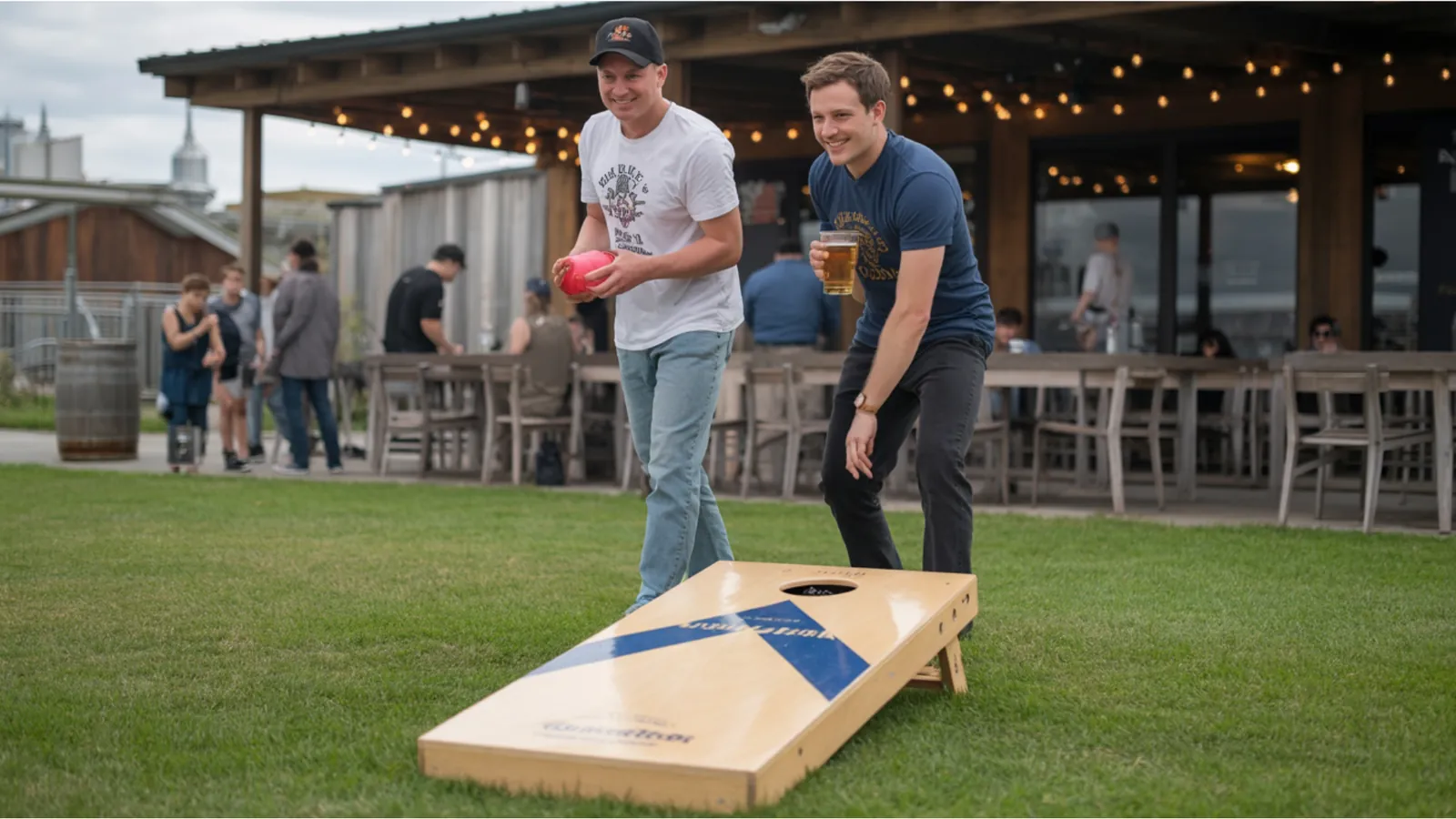
Social atmosphere. Cornhole is inherently social. Players chat between throws. Teams hang out while waiting for their turn. It pairs perfectly with food and drinks-which is why bar and brewery leagues are so popular.
Compact footprint. A regulation cornhole setup needs about 45 feet of length and 10 feet of width. You can fit multiple boards in a relatively small space, making it ideal for venues that can't accommodate larger sports.
Year-round potential. Indoor venues mean you can run leagues in any season. No weather cancellations, no field conditions to worry about.
All ages and abilities. Cornhole leagues can include 20-somethings and 70-somethings playing side by side. It's one of the few sports where age isn't a significant factor.
What Equipment Do You Need to Set Up a Cornhole League?
The checklist:
- One set of boards (two boards) for each game played at the same time
- Two sets of bags per set of boards: 4 bags of one color and 4 of another
- A scoreboard at each set of boards (flip score counters or a whiteboard)
- A tape measure for close calls
- A few spare bags
- Printed league rules posted at the boards
- Tape or markers for the foul lines, if the venue floor isn't marked
The details for each are below.
Cornhole Boards
You'll need one set of boards (two boards) per game being played simultaneously.
Options:
- Regulation boards: 2' × 4' with a 6" hole centered 9" from the top. This is the standard for competitive play.
- Tailgate/casual boards: Slightly smaller, lighter, and cheaper. Fine for casual leagues but serious players may prefer regulation.
How many sets?
| Teams in League | Boards Needed | Games at Once |
|---|---|---|
| 8 teams | 2-4 sets | 2-4 |
| 12 teams | 4-6 sets | 4-6 |
| 16 teams | 6-8 sets | 6-8 |
More boards = shorter nights (more games simultaneously) or more games per team.
Buy vs. venue-provided: Some bars and breweries already have boards. Others expect you to bring your own. Clarify this with your venue early.
Cost: Decent regulation boards run $150-300 per set. For a new league, budget $600-1,200 for boards, or find a venue that provides them.
Bags
Each game needs two sets of bags (8 total)-4 of one color, 4 of another.
Bag types:
- All-weather/recreational: Plastic pellet fill, durable, consistent. Good for outdoor or casual play.
- Pro-style bags: Different fabrics on each side (slick and stick). Preferred by competitive players. More expensive.
Let players bring their own bags or provide house bags. Many leagues allow personal bags as long as they meet the size and weight spec your league follows, usually 6" × 6" and about 16 oz.
Scoreboards
You need a way to track score for each game.
Options:
- Flip scoreboards (mounted on the board frame)
- Standalone scoreboards
- Whiteboard/chalkboard
- Smartphone apps
For league play, a visible scoreboard at each set of boards keeps things clear and reduces disputes.
Other Equipment
- Measuring tape: For close calls (which bag is closer to the hole)
- Spare bags: In case some go missing or get damaged
- League rules printout: Post the rules so everyone can reference them
Choosing a Venue
The venue makes or breaks a cornhole league. You need enough space, the right atmosphere, and a partner who's excited to have you.
Bars and Breweries
The most popular option for adult cornhole leagues. Benefits:
- Built-in food and drinks (players stay and spend money)
- Social atmosphere that fits the sport
- Often willing to provide space for free in exchange for the business
- Many already have boards or are willing to invest
What to look for:
- Enough space for your boards (45' × 10' per set minimum)
- Good lighting
- Not too loud (players need to communicate)
- Parking for your expected crowd
- Willingness to reserve space on league nights
The pitch to the venue: "I'll bring 20-40 people to your establishment every Tuesday night for 8 weeks. They'll buy food and drinks while they play. All I need is the space."
Most venues say yes.
Recreation Centers and Gyms
Indoor facilities with open floor space work well, especially for larger leagues.
- More space for multiple boards
- Climate controlled
- May charge rental fees
- Less social atmosphere than a bar
Outdoor Spaces
Parks, backyards, parking lots-cornhole works anywhere flat.
- Free or cheap
- Weather dependent
- Lighting can be an issue for evening leagues
- No built-in food/drink sales
VFW Halls, Churches, Community Centers
Often have large indoor spaces and are happy to host community events. May be alcohol-free, which changes the vibe but works for some communities.
League Format Options
Singles vs. Doubles
Singles: One player per team. Each player throws all 4 bags per round.
Doubles: Two players per team. Partners stand at opposite boards and alternate throwing. This is the most common format for leagues.
Blind draw doubles: Players show up individually and are randomly paired each week. Great for social leagues where people don't have regular partners.
Scoring: Cancellation vs. Simple
Cancellation scoring (standard):
- Bag in the hole = 3 points
- Bag on the board = 1 point
- After each round, subtract the lower score from the higher
- Only one team scores per round
Example: Team A gets 2 bags in (6 points). Team B gets 1 in, 2 on (5 points). Team A scores 1 point for the round.
Simple scoring:
- Both teams count all their points each round
- First to 21 wins
Cancellation scoring is the standard and keeps games tighter.
Game Length
Play to 21: Traditional. Can vary in length (15-45 minutes depending on skill).
Timed games: Play for a set time (15-20 minutes), highest score wins. More predictable scheduling but can feel abrupt.
Best of X rounds: Less common but works for tournament play.
For league play, "first to 21, win by 2, cap at 25" is a solid standard.
Season Structure
Round robin: Every team plays every other team. Best for smaller leagues (8-12 teams).
Divisions + playoffs: Split into divisions for regular season, then single/double elimination playoffs.
Ladder/promotion-relegation: Teams move between skill divisions based on performance. Keeps competition balanced all season.
Most cornhole leagues run 7 to 12 weeks, often 7 weeks of regular season plus a playoff week.
Rules to Establish
Don't assume everyone knows the rules. Write them down and share them before the season starts.
Key rules to define:
- Board distance: Regulation is 27 feet from front edge to front edge. Some casual leagues use shorter distances.
- Foul line: Players must release the bag before stepping past the front of the board. Define the penalty (bag doesn't count).
- Bag in the hole: Must go through cleanly. A bag that hangs on the rim but doesn't fall through is "on the board" (1 point).
- Knocked-in bags: If a thrown bag knocks another bag into the hole, the knocked-in bag counts as 3 points.
- Bags that bounce: Some leagues count bags that bounce on and stay. Others require direct landing. Clarify this.
- Scoring disputes: Who has final say? Usually the two teams work it out, but have a league official available for close calls.
- Forfeit policy: How long do you wait for a missing team? 10-15 minutes is standard.
- Substitute players: Can teams bring subs? Do subs need to be registered?
Sample League Night Schedule
Here's how a typical 8-team doubles league night might run:
6:00 PM - Venue opens, players arrive, warm-up tosses
6:30 PM - Round 1 games begin (4 games simultaneously)
7:15 PM - Round 1 ends, scores recorded, Round 2 begins
8:00 PM - Round 2 ends, Round 3 begins
8:45 PM - Round 3 ends, standings updated
9:00 PM - League night wraps up, players stick around to socialize
With 4 boards, you can run 3 rounds of games in about 2.5 hours. Each team plays 3 matches per night.
Adjust based on your team count, boards available, and venue constraints.
Pricing Your League
Use the free league fee calculator to turn your costs into a fee per team or per player, with card fees included.
Costs to cover:
- Venue rental (if any)
- Equipment (boards, bags, scoreboards)
- Prizes/trophies
- League management (your time or software)
- Insurance (if required)
Setting your fee: add up the costs above, add the profit you want, and divide by the number of teams or players. If the venue provides boards and space for free (in exchange for drink sales), your costs are minimal: pass the savings to players or put them into better prizes.
Building Your Player Base
Start with your network
Friends, coworkers, regulars at the venue. The first season is often filled by word of mouth. Ask everyone you know: "Do you want to play cornhole on Tuesday nights?"
Partner with the venue
Have them promote the league to their customers. Table tents, social media posts, announcements from staff. They're motivated-your league brings them business.
Social media
Create a Facebook group or Instagram page for your league. Post photos from league nights. People want to see that it's fun and social.
Flyers at the venue
Old school but effective. "Cornhole league starting [date]. Sign up at the bar."
Open play nights
Host a few casual "open play" sessions before the league starts. Let people try it with no commitment. Convert them to league players.
Making It Fun
The best cornhole leagues aren't just about competition-they're about community.
Ideas to boost engagement:
- Weekly prizes: Best single-round score, longest slide, etc.
- Themed nights: Costume night, rivalry week, charity night
- Season-end party: Awards, trophies, celebration
- Player stats: Track individual stats (bags in, win percentage) and publish leaderboards
- Social media presence: Post scores, highlights, and photos weekly
- Nicknames and team names: Encourage creativity
The goal: players should look forward to league night all week.
Tracking Standings and Stats
At minimum, you need to track:
- Wins and losses for each team
- Head-to-head results (for tiebreakers)
- Playoff seeding
For extra engagement, track:
- Individual stats (bags in, bags on, points scored)
- Win streaks
- Season records
Spreadsheets work for small leagues, but league management software saves time and lets players check standings anytime.
Scoring Options for Different League Types
Not every league wants to track the same level of detail. A casual bar league just wants to know who won. A competitive league wants stats.
Casual: Enter the final score of each game. Quick and easy, and right for social leagues where players don't want to track every bag.
Competitive: Track bags in, bags on and points per round for each player, which gives you bag-in percentages, points per round and individual leaderboards.
Start simple. You can always add more detail as players get more competitive.
In SportsGrove, captains enter each game's score from their phones and standings update right away. On the Growth plan, leagues can also track player stats for cornhole and show them to players.
Ready to Launch?
Starting a cornhole league is one of the easiest ways to build a community around recreational sports. Low equipment costs, flexible venues, and broad appeal mean you can get a league running in a matter of weeks.
Find your venue. Recruit your first 8 teams. Set the rules. And throw some bags.
If you want to skip the spreadsheet headaches, SportsGrove for cornhole handles registration and payment, the schedule across your boards, scores, standings and the playoff bracket in one place. Running it at a bar? See league software for bars and restaurants. Planning a one-day event? See cornhole tournament software.
Free template: cornhole league rules, plus a rainout policy and a refund policy, ready to fill in and print.
Frequently asked questions
What equipment do I need to set up a cornhole league?
One set of boards per game played at once, two sets of four bags per set of boards, a scoreboard at each set, a tape measure, spare bags and printed rules. An 8-team league runs well on 4 sets of boards.
How many cornhole boards do I need for a league?
One set (two boards) per game at the same time. For 8 teams, 2 to 4 sets; for 12 teams, 4 to 6; for 16 teams, 6 to 8. More boards means shorter nights.
How much space does a cornhole league need?
About 45 feet by 10 feet per set of boards: 27 feet between the front edges of the boards, plus the boards and room for players to throw.
How far apart are cornhole boards?
27 feet from front edge to front edge for regulation play. Some casual and youth leagues use a shorter distance.
How much should a cornhole league cost to join?
It depends on your costs: boards and bags, venue, prizes, shirts and software. Add them up, add the profit you want, and divide by the number of teams or players. The free league fee calculator does the math, card fees included.
What does a typical cornhole league season look like?
One night a week for 7 to 12 weeks, often 7 weeks of play plus a playoff night. Each night, every team plays two or three games, and standings update after each night.
How does a doubles cornhole league work?
Teams of two, with partners at opposite boards. Each player throws 4 bags per inning against the opponent at the same board, and the cancellation score goes to the team that threw more points, usually to 21.
Can you join a cornhole league without a partner?
Usually, yes. Most leagues let solo players sign up as free agents and pair them up, and some run blind draw nights where partners are drawn each week.
What does a cornhole league registration fee cover?
Usually the use of boards and bags, prizes or a payout, and sometimes a shirt or the bar's food and drink specials. The league sets the amount from its own costs.
How long does a cornhole league night take?
With 8 doubles teams on 4 sets of boards, three rounds of games take about two and a half hours, so each team plays 3 games a night.
Ready to start your league?
SportsGrove handles registration, scheduling, payments and messages, so you can focus on running great game nights.
No credit card required · 30-day free trial